
Q&A with School Shooting Expert Tom Czyz: Protecting Students Better
It’s every parent’s worst nightmare: a school shooting. Tom Czyz and his team at Armoured One have studied, deconstructed, and reconstructed so many mass casualty incidents that they stand as the foremost experts. When an act of violence occurs at a school, people call Tom in to investigate what happened… and make sure it never happens this way again.
Among other qualifications, Tom is a former SWAT Team Operator, Police Academy instructor, and firearms instructor. Tom founded Armoured One in 2012 after the attack at Sandy Hook Elementary School, putting together an expert team with backgrounds in the military, federal service, and education.
Armoured One provides active shooter training and security assessments and sells bullet-resistant glass and security film. Tom and his team have investigated more than 60 school shootings, including the attacks at Sandy Hook, Parkland, Santa Fe, and Uvalde.
We sat down with Tom to discuss how schools across the United States can better protect students and prevent school shootings. (Content warning: this interview discusses the events of past school shooting incidents.)
See more: Emergency Preparedness With SWAT Team Operator & Active Shooter Expert
Deep Sentinel: From your perspective, what contributes to violence in schools?
Tom Czyz: A hard one for people to hear is the change in how we’re raising our kids in the past 20 years. We hover over them. We protect them. They can’t be wrong.
If a teacher calls and they’ve done something wrong, the parents react immediately to defend them. Back in the day, they would let kids get in trouble. There are no real consequences for kids. So for them to be able to escalate into violence has been pretty easy.
I’m not saying it’s every parent. But in general, across society, we’re seeing a big swing in how we’re raising our kids. Accountability for our kids.
Those are all contributing factors, as well as the mental health piece that we’re seeing, of course. And everyone has talked about that. There are more mental health issues in society.
Part of that, too, is social media and how easy it is for people to be in touch with hundreds (or millions) more people than when my generation was young. You just had your peers around you that you knew, maybe at your school, maybe in adjoining schools. But other than that, you didn’t have the peer pressure.
Deep Sentinel: Is there anything different in school physical security or administration compared to 50 years ago?
Tom: They’re actually designing schools more open, where you can see more. So staff and teachers can protect the kids from bullying, fights, and things like that.
The architectural term that they use for this is called crime prevention through environmental design. CPTED has been on the increase, but also crime is still on the increase. So what is going to be the solution?
I believe CPTED is a big part of the solution, but more needs to be done with our mental health, with the schools stepping in when kids are getting picked on and parents reporting that student A is making fun of student B and doing it on social media. There’s got to be consequences, too.
If I was having that issue with employees, that one of my employees was going after another one, bullying him online, there’d be consequences for them at work. You’re not going to work together, you’re not going to be here together, if we’re going to have issues like this.
And schools most of the time refuse to do that, claiming that if their issue is out of school, it’s not the school’s problem. Well, they wouldn’t be connected if they weren’t at your school. So something needs to be done.
Deep Sentinel: What are the most common vulnerabilities in a school’s physical security?
Tom: The biggest one would be the lack of accountability for staff and students related to keeping doors closed locked and closed and not allowing people in the building who are not supposed to be in the building.
I’ve been to 61 school shootings, including Uvalde, and personally investigated them. If we look at the Uvalde attack in May 2022, the back door was left unlocked. Through our investigation, we were told that the back door was left unlocked for convenience for other staff members, and the last person who showed up should have locked it.
That is a terrible way of doing security. Imagine if our houses were the same. How do you know if you’re the last one in the house?
All doors should be closed and locked. No one should be allowed in unless they have a key or key card. If not, they can go to the main entrance and be vetted.
We see, too, where teachers and school staff members aren’t written up when they’re breaking state laws. When that shooting happened, the state of Texas mandated that exterior doors were locked, and there was no consequence for the school. They had a school policy that said the classroom door needed to be closed and locked if you had students, and that wasn’t done.
On the day of the tragedy, you can’t go back and say, “I wish I wrote you up five times so that you would understand.”
Deep Sentinel: How can schools balance the need for security with the need for a welcoming environment?
Tom: Technology has come a long way for school security. There’s a great way to keep everything hidden.
The big thing that I fight for constantly through CPTED and the committees I sit on is that we make it invisible for two reasons. One, it’s welcoming to students and parents when they show up. With my police background, I don’t want to feel like I’m walking into a jail, and I don’t want my kids to.
But at the same time, we want the bad guy to show up and assume that everything is nice and pretty and normal. And then they’re going to run into barriers and layers of protection, whether it be through AI technology and cameras that detect guns, lockdown buttons, glass that looks normal like Armoured One glass that they can’t get through, or locks that are automatically done and in place.
These keep the attacker in the dark. We have that advantage over them at that point.
Deep Sentinel: Can you speak more about the role of technology in school security, like AI firearm detection?
Tom: Pretty amazing technology.
If I pulled out a gun, it would highlight it and notify people within (sometimes) 10 seconds. The only problem… it’s great that technology exists. If you don’t have people trained to respond to that, you can detect a gun anywhere, anytime, but it’s not doing anything.
What you’ve got to remember is they’re within camera range. This means they’re on school grounds, whether they’re outside coming in or inside, and trying to go further in or get somewhere to kill someone. So that response has to be quick.
This is the same stuff that they use at the White House. That’s great. But you’ve got a hundred Secret Service agents around the White House to respond, where you might have a school with this technology, and there’s no one there to respond.
We saw at Nashville where the police were 14 minutes away. That’s the fastest they could get there.
So the technology is good, but it’s also not the solution. Everything needs to work together between training, physical security, and technology. It all has to work together perfectly to protect when an attack happens.
Deep Sentinel: How can schools involve students, teachers, and parents in creating a safer environment?
Tom: Schools have been lacking in educating the parents on what’s going on. And parents, you need to be aware that they’re not going to tell you everything, and they can’t tell you everything.
I’m not going to give out my address, when I’m out of town, where I keep my safe, the codes to my safe, the codes to my alarm, or how to shut down my cameras. I’m not going to give that information out to the public, because then somebody could attack my house, steal from me, burglarize the house, all of that.
In the same way, we can’t tell a whole school district and the parents what we have. We can give general summaries of what we have in place for security. But when it comes to awareness, they do a lousy job of preparing them in case something bad happens.
Here’s the reality. Every school district in America is going to have something bad happen there this year. And it doesn’t mean someone’s dying. It doesn’t mean someone’s being shot and killed. But bad things happen when you have groups of people. It’s not even going to be malicious all the time. But it could be a storm, a fire, a gas leak, a bomb threat, you name it, something could happen.
Preparing and educating the parents on what the processes are and having some educational videos would go a long way. So if we go into lockdown, we have a video for you, pre-lockdown, letting you know that when we go into lockdown, we are doing it to protect your children.
We’re going to follow the federal government’s “Run, Hide, Fight.” We need you not to respond to the school. Go to the secondary location. I don’t care if you were already headed there to pick up your child for a doctor’s appointment. Do not come to the school. Let first responders come to de-escalate what’s going on, or else you will be in the way, and you could make it so that your child could not be helped.
See something, say something. It might not be your child that’s making a threat against the school, but he came home and told you that he saw Steve with a gun and Steve said he’s going to shoot up the school tomorrow.
You need to say something, rather than the next day finding out… “I didn’t want to say anything. I didn’t want Steve’s parents to be mad at me.” Well, that threat has been made and he said it, so it’s got to be vetted. It’s got to be checked on. We find this stuff out all the time afterward.
What would be great is if the schools were educating the parents on what needs to be done, encouraging their kids on what should be done, and providing some education on what is going to happen. God forbid, there’s a bomb threat, the roof caves in, they’re flooded, a tornado hits, all of those different things that could happen. There should be some sort of education for them.
Deep Sentinel: Are there schools that are doing school security well? What resources or tools are they using?
Tom: About 15–20% of American schools do this well: preparing, having the proper security and safety measures in place, preparing parents, and all of that.
They’re using different resources from different conferences to learn and gain knowledge. But where we’re really seeing the success is they’ve hired the right person to run safety and security for their district.
Many times, we see that they don’t have the right people in place, that it’s a promotion, it’s a pay raise. They get to be a boss. For some people, it’s just dumped on. They’re saying, “I know you’re doing everything else. Now you’re safety and security too, and you really can’t say no and you’re just stuck with it.”
You wouldn’t put somebody in charge of CPR and First Aid who hasn’t been CPR and First Aid certified. But that’s exactly what the schools are doing. It comes down to people’s lives that could be saved or lost.
Where’s the passion for it? You’ve got to hire someone who’s passionate, knowledgeable, and willing to be humble in that position, too.
Deep Sentinel: What resources are available for schools looking to improve their security?
Tom: There’s great active shooter training. They should be doing certified active shooter training where people are quizzed on what they were taught to make sure they retain and understand it. That helps protect them personally from liability. If you just claim you taught people, and they turned on a video and walked away, they can say there’s no accountability.
There are great companies and great conferences that they should be going to.
And then great products. One that I’d want to push is a test certification called the ASTM F3561. ASTM is an over 125-year-old independent testing company. They create different standards for all sorts of products.
This ASTM F3561 is a shooter attack test that’s done on glass doors and locks. It’s shot to a standard based on the history of active shooters. That means they’re shooting it 10 times with an AR-15, and then they’re attacking it with a 100-lb ram in measurable amounts of force.
And this proves that products will actually work when they’re shot and hit. Is a door going to keep a bad guy out when he’s attacking it? Is the lock, the hinges, the glass, or the frame actually going to stop them or slow them down? You can prove that through the ASTM test.
It was a brilliant test created by incredible people who are experts in the field of physical security, glass, active shooters, and all of those things to mimic these attacks and let customers know that we’re protected at least to this level compared to the other nonsense that’s out there.
You could easily just say, “I want my glass to the ASTM F3561 standard,” or “my locks” or “my doors” or “the hinges or “the framing.” Any of the fenestration that’s set up for the entry. You can shop through a hundred different companies that have those products. But you know that they meet those standards. And you can buy what you want, what you can afford, what you like, the way it looks, any of that. That’s done the right way, I would say.
Deep Sentinel: What strategies can schools use to respond to an active shooter situation effectively?
Tom: I would definitely use “Run, Hide, Fight.”
But also, from an admin level, you need to empower your people to respond quickly. A lot of people hesitate. They don’t call a lockdown. They don’t call 911. They’re too scared to react because they might be wrong. You need to go with your gut.
I will promise you this as a retired cop. We love speeding to calls. So if you call 911 because you think you hear gunshots at a school, and the cops go 130 mph to get there, not one of those cops is going to be mad at you or upset that they sped there. That’s part of what we signed up for when we became cops.
The thing is, if we have that advantage, and we get there quickly, we can actually save lives and make a difference. But we find out a lot of times that the average 911 call takes 60 to 90 seconds to come in on a shooting.
People are waiting. They’re unsure. They assume everyone knows. If we can get them moving quicker, they can run, hide, or fight—and it’s not necessarily in that order. They can then be in a place of being ready, and the shooter might be locked out in the hallways with doors barricaded. They’re ready to fight inside or they can jump out of windows and take off.
We saw that in the Virginia Tech shooting—the ones that lived and had almost no injuries, other than some sprained ankles. They jumped out of the second floor. And they ran. And they got away. None of them were shot, and none of them were killed.
When you have that advantage, it can save your life to react the proper and correct way.
Deep Sentinel: How can schools better collaborate with law enforcement agencies to prevent and respond to threats?
Tom: I would say 50% of schools across America do a very good job of working with their police departments. Another 25% of them don’t want the police involved at all at their schools.
We could look at Los Angeles schools as an example. They had the largest school police department in the nation, and they’ve definitely dwindled down. They’re not even close to the largest anymore. I believe they have something like 200 officers protecting 1,400 campuses, and they’re not allowed on the campus. They have to patrol the outside until they’re called in.
That’s not proactive at all. That’s not going to help deter violent crimes. You need to have someone proactively there just by the sheer number of people.
People fall under the pretense that cops are patrolling schools because they’re there to make arrests. The goal of a good school resource officer program is not to make arrests. It’s to intervene in that child’s life before they make the wrong decisions that put them on a path to prison.
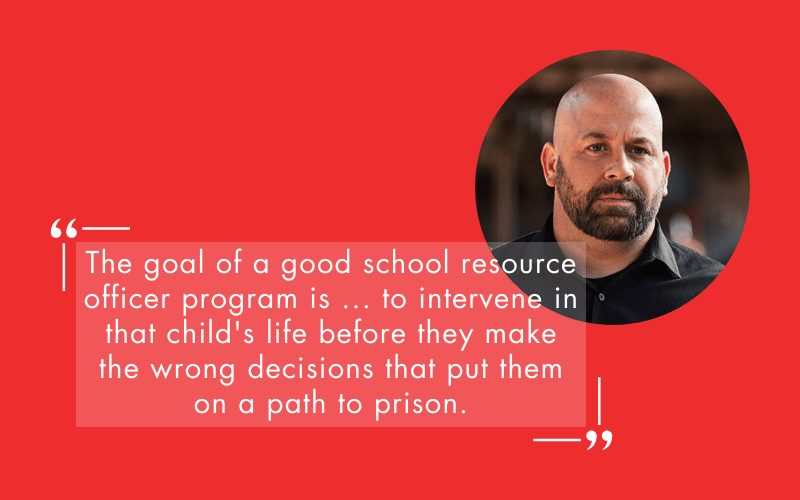
A majority of school police officers that I have met, the SROs, have been in a situation where they want to intervene. They want to turn the kids’ lives around, they want to give these kids not only another chance but another chance and another chance and another chance. How can we prevent them from being arrested and going down the wrong path?
Because what we don’t want is for them to graduate and become a career criminal. That makes it harder for us.
Cops are getting paid whether we arrest nobody or we arrest a thousand people a year, right? It’s not like they’re getting a bonus based on more crime. They want less crime to make their jobs easier and hopefully guarantee they go home at night.
So with that, a big positive thing would be to have the police involved way more and in positive ways, which a lot of them do. Giving them more interaction with the schools. Giving them more guidance on what needs to be done.
Deep Sentinel: What are some lessons from past school shootings that can help schools enhance their security?
Tom: Definitely closing and locking doors. That’s a huge one that we see all the time, that [the shooters] have free reign.
And I’m not just talking about a classroom door or the exterior door. I’m talking about the fire doors that are inside the building. They might be called smoke doors or barrier doors—they call them all different things in each state. When the fire alarm goes off, these doors are held open magnetically and they swing shut.
They’re made for egress. If the door is swinging shut, the state fire marshal and architects have made a decision based on codes that you’re only allowed out of this area. We don’t want you back in.
If you think about a shooting like Parkland… well, we can even talk about an even more recent incident for people: the Nashville shooting. The shooter comes to the building, shoots their way through the glass, and makes their way through a side door, killing three adults and three students. But that attacker killed the three students on the second floor.
The fire alarm went off immediately when the attacker was shooting on the first floor, killing Mike Hill, the first victim, the assistant head of facilities. When Mike Hill is killed, the fire alarm goes off. And it’s screaming loud, and it’s causing confusion. And kids exit their classroom upstairs, just like they did in Parkland five years before.
The same exact thing happened in Parkland. The fire alarm went off, and the shooter was able to get to the second and third floors.
If those doors were locked, they wouldn’t have been able to get upstairs. And when they got up there, the confusion had students in the hallway instead of in their classrooms, barricaded, hidden, or prepared to fight.
And that happened in Nashville, five years later. We didn’t learn we had to turn the volume down on the fire alarms. We need to have speaking fire alarms instead of just a blaring noise. And that’s now becoming legal in states.
Think about the police trying to communicate during these, too. You’re screaming at each other. You can’t communicate well. There’s no need for a blaring fire alarm to be as loud as it is.
When I talk to state officials, and they tell me about the blaring alarm, they say it’s for the hearing impaired. If they’re hearing impaired, there are flashing lights, right? It’s mandated in every state that there’s a flashing light as the alarm’s going off. So there’s your visual indicator. If you have an impairment, you’re going to have an assistant in a school.
So. Locking those doors. Making it so that we educate, we turn down the volume, or we change it to talking fire alarms. These are key lifesaving things.
We just don’t learn our lessons. We just keep getting hit. People die and they say, “Oh, well, I don’t know what else we could have done.” And there’s a lot that we could do.
Deep Sentinel: It is so bleak, but at the same time, so interesting, the work you do.
Tom: I’m with you. It’s like doctors trying to stop a virus. We’re figuring out how it keeps happening. We see the same thing over and over, but we don’t get the audience to listen to us.
Recently, I was in Tennessee. They created a bill with a minimal standard of law of what schools need to do for glass, and it’s not going to create any security. It’s absolute nonsense, the way they’ve worded it. The schools basically can put up anything they want and hope it works. They’re just mandating that they do it. There’s no minimal standard for it.
They claim that it’s entry-resistant. I can put paper on my windows and claim it’s entry-resistant. How are you going to spend that in court? If they shoot it and attack it, they’re going to do the same thing that happened at the Covenant Presbyterian School shooting in Nashville.
So you’ve wasted not only passing a bill, but you’ve also created a false sense of security. They think if they put anything up, it’s better than nothing. And that’s not true at all.
They won’t prepare. They think it’s bulletproof and all this nonsense about what they’re doing. The same thing is going to happen again where the schools are going to be attacked.
Not to mention you’ve wasted taxpayers’ money on products that don’t work. Some companies make garbage. They sell billions of dollars of it. They’re paying lobbyists to vote a certain way to make sure they can sell their product.
They don’t care about your kids. They don’t care about your schools being protected. They care about making money. And that’s been proven over and over again.
Deep Sentinel: If you could tell things schools one thing to improve the safety of their students, what would it be?
Tom: Train your staff. Give them proper training to the federal level of “Run, Hide, Barricade, and Fight.” That would be my number one.
You can have all the physical measures in place, whether that’s glass or doors or locks or lockdown systems, blue light systems flashing, and letting everyone know they’re in lockdown. But all it takes is the human error of not responding the right way.
If you train your people, that’s what can save lives. They would take your kids, and they would protect them. They would know what to do.


Need a Solution that Prevents Crime? Deep Sentinel is the only security technology that delivers the experience of a personal guard on every customer’s home and business. Call 833.983.6006 for your free security consultation.