
Apartment Complex Security: How Live Video Guards Stop Crime Before Residents Notice
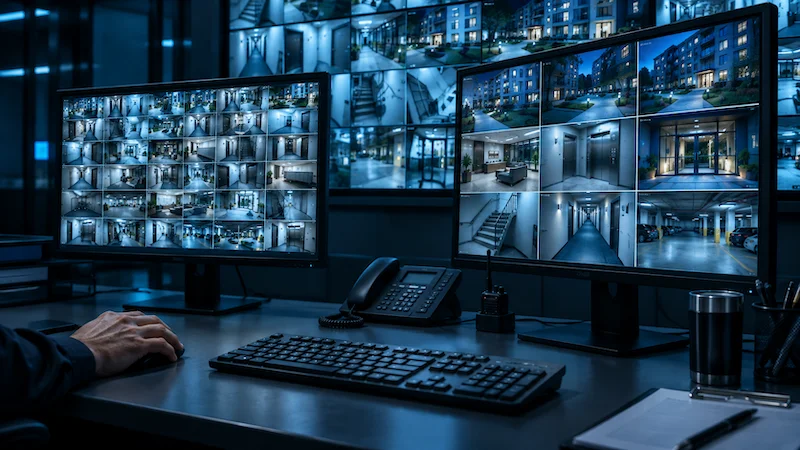
The weakest hours for apartment complex security are the ones when residents are asleep, and the leasing office is dark. That is when car windows get smashed, pool fences get climbed, and strangers test door handles in the garage. According to the Bureau of Justice Statistics (Criminal Victimization, 2024, published September 2025), urban households experienced 181.6 property victimizations per 1,000 households. That is nearly double the national rate of 97.6, and only about 30% of property crimes were reported to police.
Live video guards close that gap by catching trouble while it is still happening. Below, you will see how the process works second by second, how it compares with an onsite guard on cost and coverage, and how to decide whether it fits your property.
Why Apartment Complexes Are Hard to Protect After Hours
Apartment communities combine valuable targets, shared access points, and constant foot traffic, so a stranger rarely stands out. Most of the property also goes unwatched overnight, even when cameras are recording.
Losses and liability concentrate in a few predictable spots:
- Parking lots and garages: vehicle break-ins and catalytic converter theft take minutes and often go unreported.
- Vehicle gates and perimeter fences: tailgating and gate hopping defeat access control without triggering any alert.
- Pools, gyms, and clubhouses: after-hours trespassing leads to vandalism and creates injury liability for the owner.
- Trash enclosures and loading areas: illegal dumping and loitering happen out of sight lines.
- Vacant units under renovation: appliances, copper, and tools attract theft, and empty units attract squatters.
When most incidents never reach police, problems surface later as resident complaints, one-star reviews, and non-renewals instead of as data a manager can act on.
What Live Video Monitoring Adds to Apartment Complex Security
Live video monitoring pairs cameras with AI detection and trained remote guards. The guards watch flagged events in real time and intervene through speakers on the cameras. A recorded system documents a crime. A monitored one tries to stop it.
The service works in three layers:
- AI detection filters motion, so guards see people and vehicles, not swaying branches, headlights, or stray cats.
- Live guards verify what is happening and respond with two-way audio, sirens, or lights.
- Police dispatch gets a verified, crime-in-progress call with a description and direction of travel, which an unverified alarm signal cannot provide.
How Live Video Guards Stop a Crime in Progress
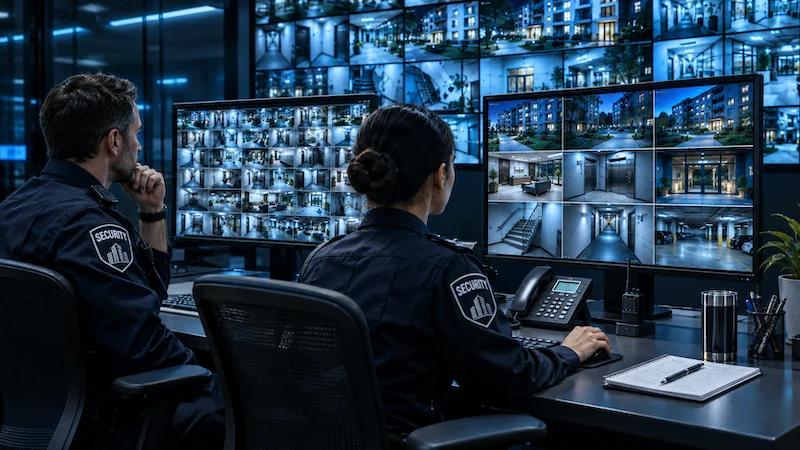
Live video guards shrink the time between the first suspicious movement and a human response to seconds. With Deep Sentinel, cameras start recording within 2 seconds of motion, and a guard is watching within 10 seconds. When a threat is confirmed, police are contacted within 30 seconds.
Here is the sequence on a typical alert:
- Detect motion at the camera, which begins recording immediately so no part of the event is missed.
- Analyze the footage with on-site AI to separate a likely threat from routine activity.
- Route confirmed alerts to a live guard, who watches the feed and judges intent.
- Warn the person through the camera speaker, describing them specifically so they know a real person is watching.
- Escalate with a siren and a police call if the person ignores the warning or a crime is underway.
- Document the event with a clip and incident notes the manager can use for insurance, police follow-up, or lease enforcement.
What a 2 a.m. Incident Looks Like From Start to Finish
Picture a 180-unit garden-style community with three surface lots. At 2:14 a.m., a man walks the rows behind Building C, pulling on door handles. By the 10-second mark, a guard is watching him.
The guard speaks through the camera: “You in the grey hoodie next to the white pickup, this property is under live surveillance and police are being notified.” Often, a specific warning like that is enough to send someone back over the fence. If he keeps going, the guard contacts law enforcement with his description and direction of travel while the siren sounds.
By morning, the manager has a clip and an incident report. The pickup’s owner leaves for work with an intact window and never learns anything happened.
Apartment Complex Security Guard vs. Live Video Monitoring: Which Works Better?
Each option protects a different slice of the property, and the right choice depends on how much ground you need covered at once. The table compares the five most common approaches on the criteria that matter at 2 a.m.
|
Option |
Coverage at one moment |
Acts during the incident |
Main cost driver |
Biggest weak point |
|
Onsite guard (one post) |
What one person can see from a post or patrol route |
Yes, if the guard spots it |
Wages for every hour of coverage |
Blind spots during patrols, breaks, and fatigue |
|
Mobile patrol |
One property visit at a time |
Only if the timing lines up |
Number of nightly drive-bys |
Hours of no coverage between visits |
|
Recorded cameras only |
Every camera view |
No |
Hardware and storage |
Footage gets reviewed after the loss |
|
Alarm sensors |
Doors and gates with sensors |
Siren only, unverified |
Monitoring contract |
False alarms and no visual confirmation |
|
Live video guards |
Every monitored camera at once |
Yes: voice warning, siren, police call |
Number of cameras monitored |
Depends on good placement and lighting |
Research supports active monitoring over recording alone. Piza, Welsh, Farrington, and Thomas published a 40-year meta-analysis in Criminology & Public Policy (2019), summarized by the U.S. Office of Justice Programs. It found significant crime reductions in parking lots and residential areas, with actively monitored systems producing larger effects than passive ones. The authors also cautioned against using cameras as a stand-alone measure, so lighting and access control still matter.
For more on the trade-offs, see the breakdown of onsite guards versus remote surveillance for multifamily properties.
How Much Does a 24/7 Apartment Complex Security Guard Cost?
One guard post staffed around the clock costs more than $13,000 a month in wages alone at national median pay. That is before payroll taxes, benefits, overtime, or agency markup. The U.S. Bureau of Labor Statistics (Occupational Outlook Handbook, updated August 2026) reports a median annual wage of $38,020 for security guards as of May 2025, or about $18.28 per hour.
The math for a single 24/7 post:
- A month of continuous coverage is about 730 hours.
- At $18.28 per hour, that comes to roughly $13,340 in base wages.
- Filling those hours takes four to five full-time employees once you account for days off, vacation, and sick leave.
Contract agencies bill well above the wage to cover insurance, supervision, and profit, and that post still sees only one area at a time.
Tip: Compare options by how much of the property gets real-time coverage per dollar, not by hourly rate. A cheaper guard who can see one lot costs more per protected space than monitoring that covers all three.
Which Areas Need Apartment Complex Security Cameras First?
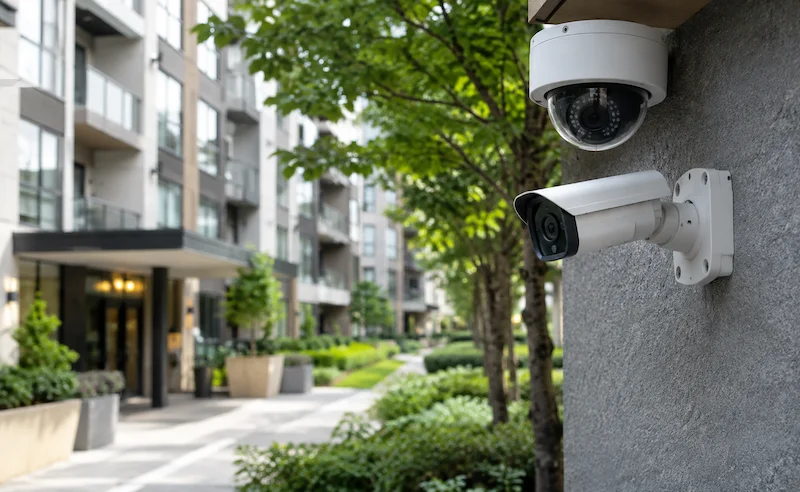
Start where theft, liability, and entry points overlap: parking, gates, and main building entrances. Then work outward to amenities and back-of-house areas.
- First priority: parking lots and garages, vehicle gates, and main pedestrian entrances, where property crime and unauthorized entry concentrate.
- Second priority: pools, fitness centers, and clubhouses after hours, plus trash enclosures and loading zones.
- Third priority: the leasing office exterior, maintenance shops, and units under renovation.
Mailrooms need their own plan. Cameras provide evidence, but lockers, delivery windows, and resident notifications do more of the prevention work, as covered in these steps to reduce package theft at multifamily properties.
Note: Put parking cameras where light is strongest. A guard cannot describe a suspect to police from a silhouette.
Common Mistakes When Choosing Apartment Complex Security Systems
Most failures come from buying equipment without a response plan behind it. These mistakes show up again and again:
- Recording without watching. Footage supports an insurance claim, but the window is already broken by the time anyone sees it.
- Covering buildings but not paths. Thieves approach through lots, fence lines, and side gates, so cameras aimed only at doors miss the approach.
- Ignoring lighting. Dark corners cut image quality and give guards nothing useful to report.
- Choosing by hourly rate. The lowest bid for one guard often buys the least coverage per dollar.
- Skipping resident communication. Residents startled by a voice from a camera will call the office, so explain in advance how monitoring works.
- Setting it and forgetting it. Incident patterns shift, so review reports every quarter and move cameras toward new hot spots.
Coverage gaps can also weaken an owner’s position when a crime leads to a claim. Read more about the legal duty of reasonable care owners owe residents, and confirm requirements in your state with an attorney.
How to Decide If Live Monitoring Is Right for Your Property
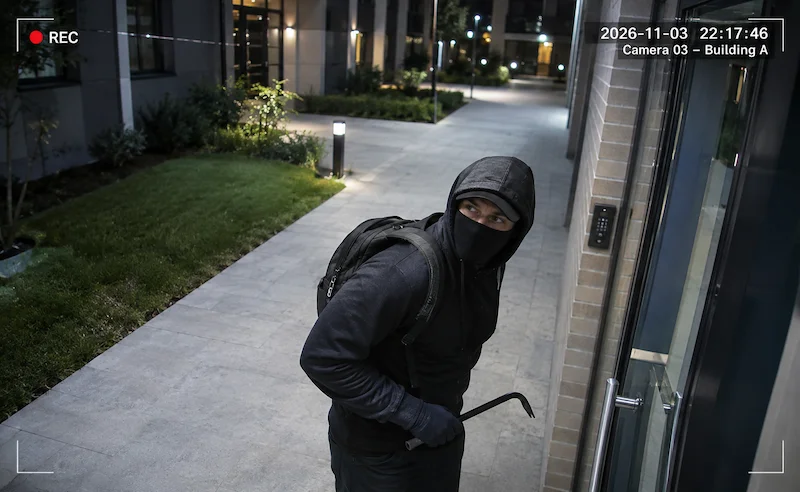
Live monitoring is usually the stronger fit when your risk is spread across a large footprint and peaks overnight. If two or more of these apply, put it at the top of your list of apartment complex security solutions:
- You have had repeat car break-ins, trespassing, or vandalism in the last 12 months.
- Your property spans multiple buildings or parking areas that one guard cannot see at once.
- Most incidents happen between late evening and early morning.
- You already own cameras that record but nobody watches in real time.
- Your guard or patrol spending keeps rising while incidents do not fall.
An onsite guard still makes sense when you need someone physically present for lockouts, concierge duties, or rule enforcement at the pool. Many communities combine both: a daytime concierge and live video guards overnight. That layered model is often the most cost-effective security for apartment complexes with more than one building.
How to Get a Security Plan Built for Your Apartment Community
If overnight car break-ins, gate hoppers, or after-hours trespassing are costing you renewals, the next step is a camera-by-camera coverage plan. Deep Sentinel’s team will review your site layout and map the priority zones above. They will also price live guard monitoring for multifamily communities against what an onsite post costs you today. Call 833.983.6006 to request a free security consultation and see where your current setup leaves gaps.
Frequently Asked Questions
Can I keep my existing cameras and still add live remote guards?
Yes, in many cases. Deep Sentinel’s Bring Your Own Camera service supports a range of third-party camera models, so you may not need to replace hardware that already works. Check the list of supported third-party camera integrations for your make and model. Older cameras with weak night performance are usually worth replacing at your highest-risk spots.
Should I keep my onsite guard after adding live monitoring?
It depends on what that guard does. If the role is mainly overnight watching, live monitoring can usually replace it while covering more ground. If the guard handles lockouts, visitor check-in, or amenity rules in person, keep a daytime shift for those tasks and let remote guards cover nights. Review three months of incident reports first to see when problems happen.
How many cameras do I need to cover my apartment complex?
You need enough cameras to see every vehicle and pedestrian entry point plus each parking area without blind spots. A single-building property may need a handful, while a multi-building community with several lots needs far more. The fastest way to a real number is a site walk or satellite-map review that marks entrances, lots, amenities, and known trouble spots.
What should I do if a guard flags a resident by mistake?
Usually nothing, because guards are trained to address people calmly first. If a resident is searching for their keys late at night, the guard confirms they belong there and moves on. Guards can also contact you directly to clear up confusion. Telling residents in advance that cameras are monitored live prevents most surprised calls.
Do I need to tell residents that cameras are monitored live?
You should, even where the law does not require it. Rules for video and especially audio recording vary by state, so check with your attorney before installation. A short notice in the resident portal plus signage at entrances reduces confusion. Visible signs also deter crime by telling would-be thieves the property is actively watched.
How long does it take to get live monitoring running?
A small property can be up within a day. Deep Sentinel’s wireless cameras can be self-installed in under 30 minutes each, which suits smaller sites. Larger communities usually choose hard-wired PoE cameras with professional installation, so timing depends on cabling, camera count, and installer availability.
Is live monitoring worth it for my small apartment complex?
Often, yes. A small property rarely can afford a 24/7 guard but still faces the same overnight break-ins and trespassing. Monitoring cost scales with camera count, so a 20-unit building with one lot and two entrances pays for a few cameras rather than a full-time post. For small-property apartment complex security, start with the parking area and main entrance, then expand if incident reports show new problem spots.

